
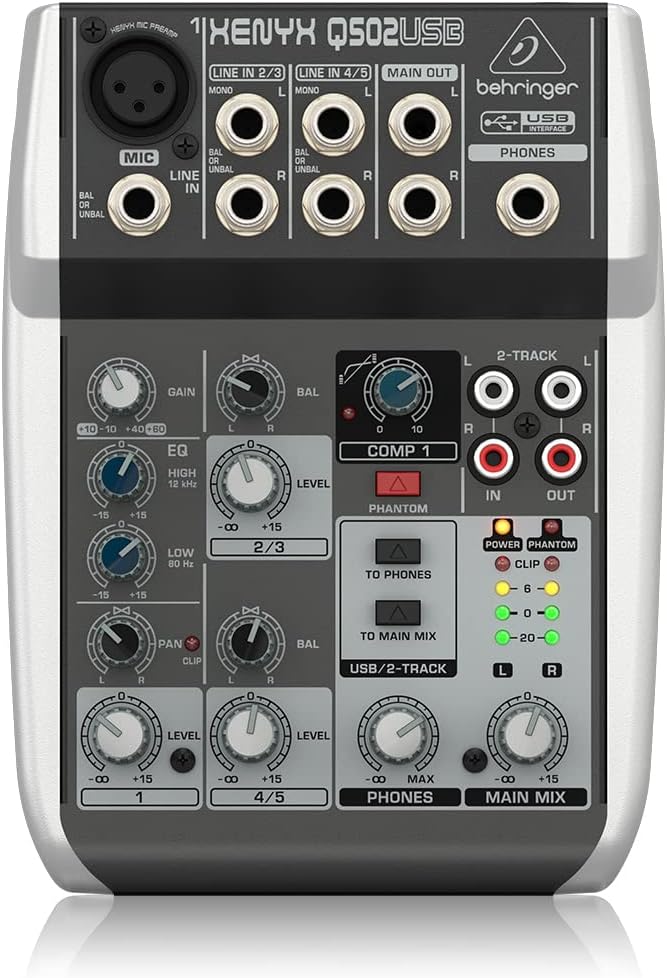

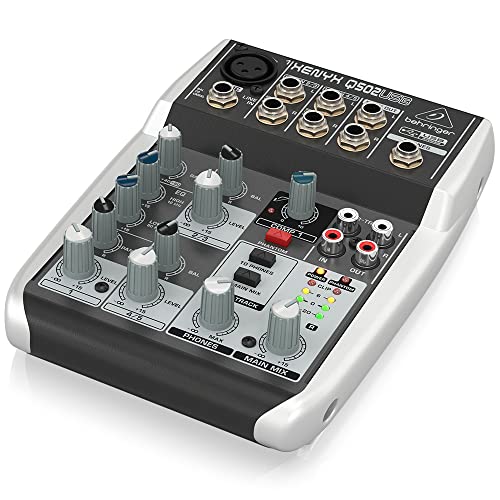


My read on the BEHRINGER Xenyx Q502USB is simple: this is a small USB mixer for people who want physical audio control at a computer desk without moving into a larger mixing setup. The recorded dimensions are 7.24 x 5.43 x 1.81 inches, and at 2.65 pounds it is clearly built for a compact workstation, podcast corner, streaming desk, or small writing setup rather than a rack or multi-room studio.
Why I’d consider the Xenyx Q502USB for a small computer setup
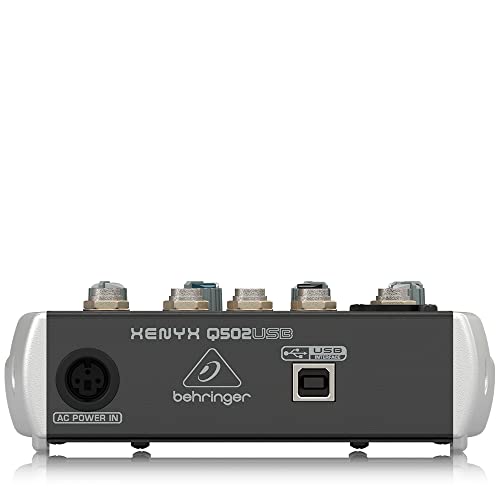
The Q502USB works with Mac and Windows, connects over USB, and is listed with ASIO support. That matters most on Windows, where ASIO is commonly used by recording software to help keep latency manageable. I would look at this mixer if I wanted a straightforward box between a microphone, an instrument, or another audio source and a computer.
The connector list includes USB, XLR, 1/4 inch, and composite connections. That gives it enough flexibility for a modest mixed setup: a microphone connection, line-style inputs from gear that uses 1/4-inch cabling, and USB to the computer. I would not buy it expecting a big studio control center, but as a small desktop hub, the spec sheet makes sense.
Where the Q502USB makes the most sense
I’d place this in the category of practical, space-saving audio tools. If I were setting up a single-person podcast desk, a voiceover corner, a compact streaming arrangement, or a songwriter’s laptop station, this is the kind of mixer I’d consider. The appeal is not that it replaces a larger system; it is that it gives you hands-on level control in a small footprint.
I also like the idea of having knobs in reach instead of handling every adjustment inside software. For quick recording, calls, rehearsals, or simple content work, that can be a cleaner way to manage levels. The Q502USB model name also tells me this sits in BEHRINGER’s smaller Xenyx range, so I’d keep expectations realistic: convenience, basic routing, and USB connectivity are the main reasons to look at it.
The limitation I would not ignore
The biggest limitation is scale. This is not the mixer I’d choose for several microphones, complex monitoring, or a setup that needs plenty of room to grow. It is also corded electric, so I would not treat it as a battery-powered field solution. Before ordering, I’d check the exact sources I planned to connect and make sure I had the right XLR, 1/4-inch, USB, or composite cabling for the job.
Who should skip the BEHRINGER Q502USB
- Multi-mic podcast teams: I would look at a larger mixer or interface if several people need separate microphone channels.
- Remote recording away from power: this is a corded electric unit, not a battery-based field tool.
- Large studio routing: anyone needing complex outputs, monitoring, or expansion should move up to a bigger system.
- People wanting the fewest cables possible: USB, XLR, 1/4-inch, and composite sources still require the right physical connections.
Reviews
There are no reviews yet.