
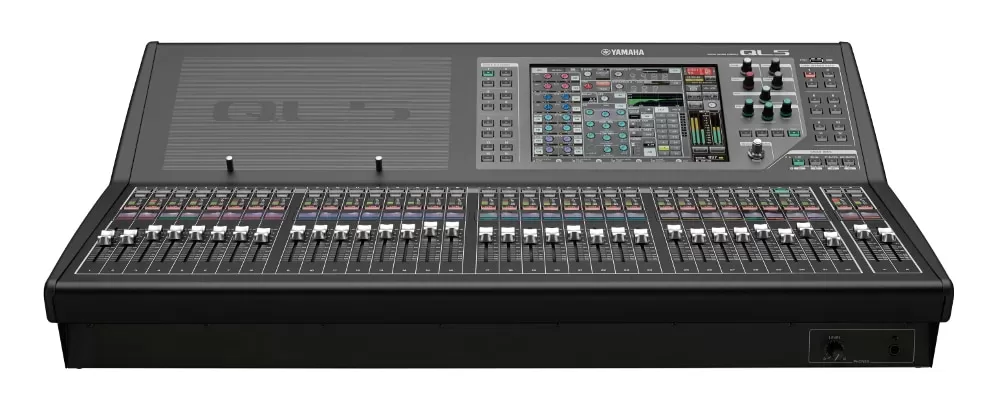

When I look at a large-format mixer, I start with one practical question: will it keep a busy show organized without forcing the engineer into awkward compromises? On paper, the Yamaha QL5 is aimed squarely at that problem. With 64 mono channels and 8 stereo channels, this is not the kind of board I’d point at a simple vocal-and-guitar setup. My read is that Yamaha built the QL5 for productions where the input list keeps growing and clean source separation matters.
Why the Yamaha QL5 Channel Count Matters
The headline spec here is the channel capacity. 64 mono channels gives plenty of room for individual microphones, instruments, playback lines, talkback-style sources, and other single-channel inputs without immediately combining things just to make the board fit the show. That matters because once sources are grouped too early, fine control gets harder.
The 8 stereo channels also make sense for the kind of systems I’d associate with this mixer: keyboards, media playback, computer feeds, stereo ambience, or any left-right source that should stay paired. If I were planning a rig around the QL5, I’d be thinking about productions with layered inputs, not minimal stage plots.
What 48.1 lbs. Says About the QL5 in a Real Setup
At 48.1 lbs., the QL5 is not something I’d treat as a casual grab-and-go mixer. That weight tells me it belongs in a planned control position, a proper case, or a mobile rig where load-in is handled deliberately. It may be manageable in the context of a serious console, but I would not buy it expecting effortless one-person portability.
The grey finish is the least dramatic part of the spec sheet, and that is probably the point. It should sit visually quiet in a professional environment rather than calling attention to itself. Still, color is not the reason to choose this mixer. The reason is scale: the QL5 is about having enough channel space to manage demanding input lists.
Who I Think Should Buy the Yamaha QL5
I’d consider the Yamaha QL5 for venues, production teams, schools, houses of worship, and engineers who regularly face complex shows with many mono sources plus several stereo feeds. If I were buying at this level, I’d want to be sure my typical work actually needs that much channel capacity, because otherwise the size and weight become harder to justify.
- Choose it if you need substantial channel space for larger, more organized mixes.
- Think carefully if frequent transport and fast one-person setup are major priorities.
- Skip it if your work rarely goes beyond a few microphones and a couple of playback sources.
Reviews
There are no reviews yet.