
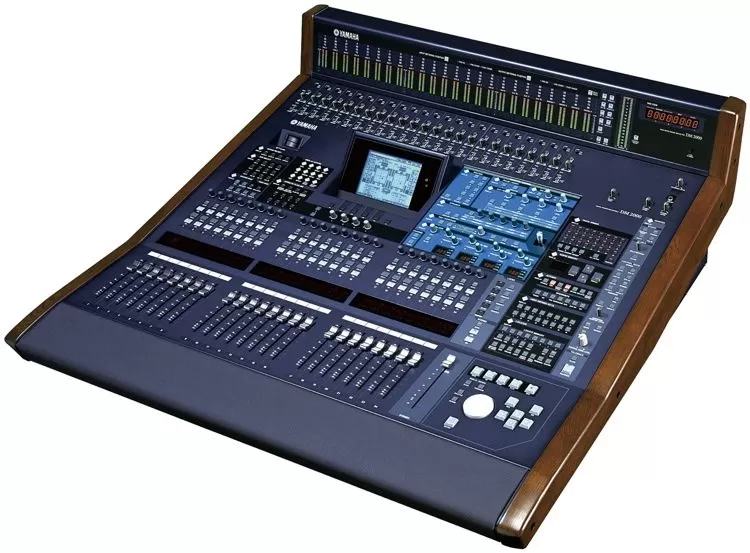

The Yamaha DM2000VCM is the kind of mixer I would only consider for a serious, fixed audio setup. On paper, the headline is obvious: 96 channels. That puts it far beyond the needs of a small podcast desk, a bedroom production corner, or a simple rehearsal mixer. It is a blue, large-format Yamaha console, and at 43kg / 94.8lbs, I would treat it as furniture as much as equipment.
Why the 96-Channel Count Matters
My read of the DM2000VCM is that its value starts to make sense when a session or room has a lot of sources to manage. Drums, vocal groups, keyboards, backing tracks, playback feeds, effects returns, and other routing needs can quickly make a smaller mixer feel cramped. With 96 channels, I would expect the main appeal to be organization: fewer compromises, less early submixing, and more room to keep sources separated.
That said, more channels do not automatically make a system easier. I would not recommend this to someone who is still learning basic signal flow. A console at this scale asks for a user who already understands routing, gain structure, monitoring, groups, and session planning. If the rest of the room is simple, the DM2000VCM is likely more mixer than the job requires.
Planning Around a 43kg Console
The weight is not a small detail. At 43kg / 94.8lbs, I would not plan to move this casually or place it on a lightweight desk. Before ordering something like this, I’d want to confirm the workstation, stand, or studio furniture is stable enough, wide enough, and arranged with cabling space in mind.
I’d also plan the room around it rather than trying to squeeze it into an existing corner. A mixer with this much channel capacity deserves clear labeling, sensible cable management, and a routing plan. Without that, the scale becomes a problem instead of an advantage.
Where I Think the DM2000VCM Makes Sense
I’d look at the Yamaha DM2000VCM for a control room, broadcast room, production suite, rehearsal facility, or complex live setup where many sources need to remain available at once. If I were buying at this level, I would want the rest of the system to justify the channel count: enough sources, monitoring needs, and recording or routing hardware to make 96 channels useful.
Who I’d Tell to Skip It
- Bedroom producers: the size and 43kg weight are hard to justify in a small room.
- Beginners: I’d start with a simpler mixer before moving into a console of this scale.
- Portable rigs: this is better suited to a fixed installation than frequent transport.
- Simple vocal, podcast, or instrument setups: 96 channels will likely be unnecessary.
My Bottom Line on the Spec Sheet
I see the Yamaha DM2000VCM as a serious-capacity console for users who already know why they need that many channels. The honest limitation is that the same scale that makes it attractive for complex rooms makes it excessive for simple ones. I would not buy it just because it is big; I’d buy it only if the room, workflow, and source count genuinely demand a 96-channel Yamaha console.
Reviews
There are no reviews yet.