
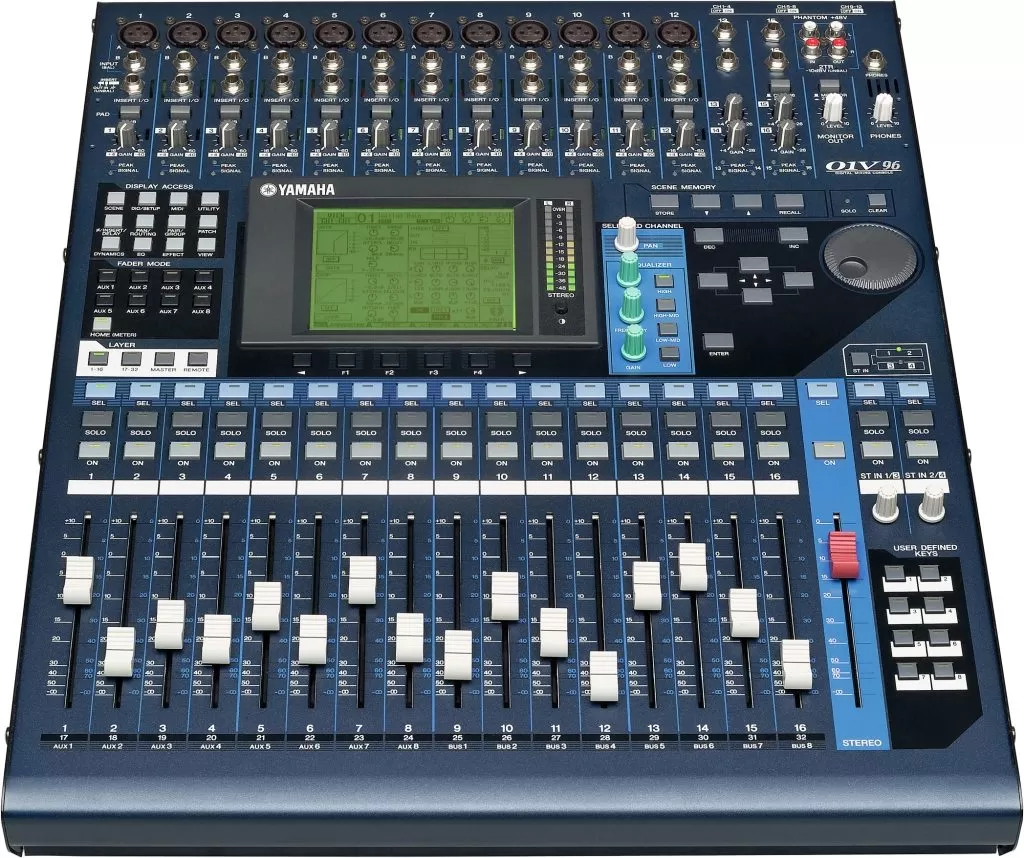

When I look at the Yamaha 01V96, I do not see it as a “buy the biggest mixer you can” kind of product. My read of the spec sheet is simpler: this is a 16-channel Yamaha mixer for people who need a real central mixing point, but who do not want to move into oversized-console territory. At 12.5 kg / 27.5 lbs, it sits in that useful middle zone between compact utility mixers and desks that feel tied to one room forever.
Why the 16-channel count matters here
The main reason I would shortlist the Yamaha 01V96 is the channel count. Sixteen channels can cover a disciplined small band, a rehearsal room, a modest recording setup, a house-of-worship rig, or a presentation system with several microphones and playback sources. If your input list is planned carefully, that size can keep the whole system easier to manage than a larger board with rows of channels you rarely touch.
That said, I would be strict about counting sources before ordering one. Sixteen channels can disappear quickly once you add multiple vocal mics, instruments, stereo sources, extra playback devices, or several wireless microphones. If your normal setup is already close to that limit, I would not buy the 01V96 expecting it to feel roomy for long.
The blue Yamaha desk as a movable control point
The listed weight of 27.5 lbs tells me this is transportable, not casual. I would be comfortable thinking of it for a cart, rack area, studio desk, church booth, rehearsal space, or small venue position. I would not treat it like a tiny throw-in-the-backpack mixer. It deserves a stable table, stand, or case, especially if it is going to be moved regularly.
The blue finish is not the reason to buy a mixer, but I do like that it makes the 01V96 easier to spot in a sea of black gear. In a shared live or install environment, quick visual identification is a small but practical advantage.
Who I would and would not point toward the 01V96
I would consider the Yamaha 01V96 for someone who wants a recognizable Yamaha mixer with a clear 16-channel ceiling, enough physical presence for organized work, and a weight that still allows relocation with care. It makes sense when the system has outgrown a very small tabletop mixer but does not justify a much larger console.
I would skip it if you only need one or two microphones, a tiny podcast-style setup, or the lightest possible tabletop solution. I would also skip it for larger productions where 16 channels will be a constant constraint. Before building around it, I would list every source that must connect at the same time and leave a little room for growth.
Reviews
There are no reviews yet.