
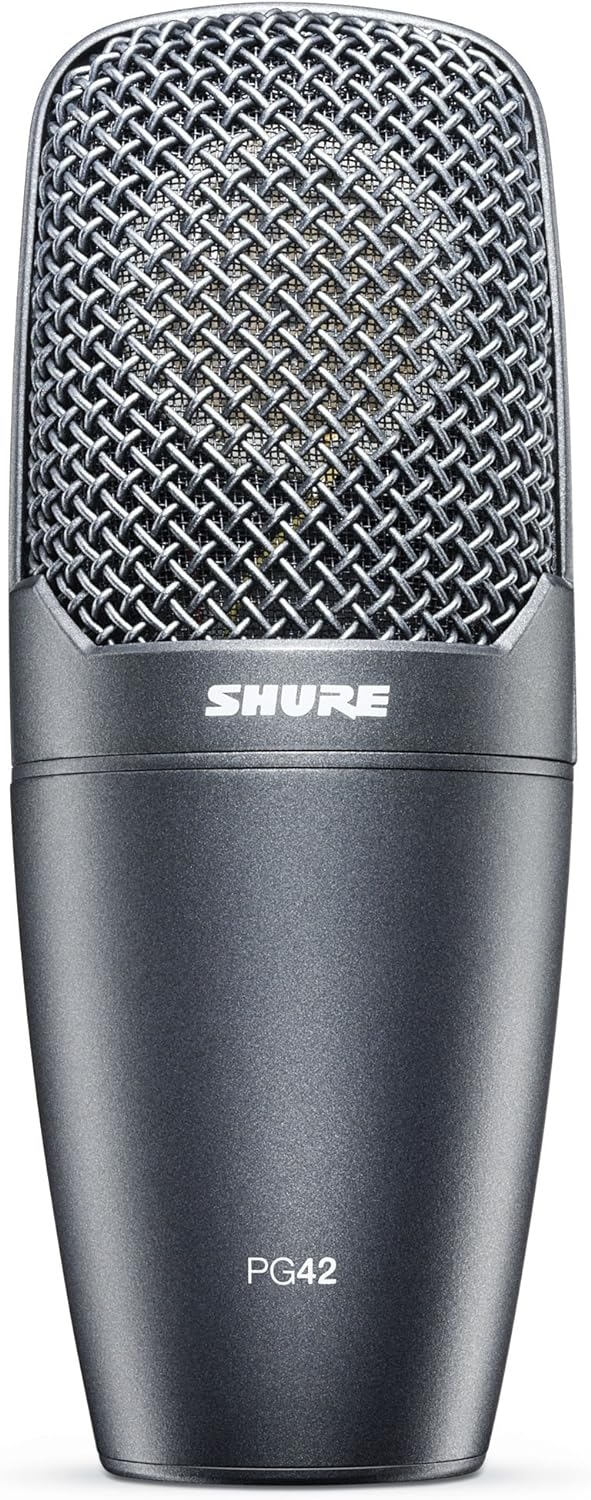

My read on the Shure PG42-LC starts with the connection: this is an XLR condenser microphone, not a plug-and-play USB option. That matters. I’d only put it on a shortlist if you already have, or are ready to buy, an audio interface, mixer, or preamp that can supply phantom power. Without that, the microphone is only part of the purchase.
PG42-LC Setup: XLR and Phantom Power Come First
Because the PG42-LC is a condenser microphone, it requires phantom power to operate. That immediately places it in a more traditional recording setup, where the mic feeds dedicated hardware before reaching a computer or recorder. I like that kind of chain for people who want more control over gain, monitoring, and routing, but I would not recommend it to someone who just wants the fastest way to join calls or record directly into a laptop.
The listed weight is 1.3 pounds, and the product dimensions are 13.6 x 4.6 x 9.9 inches. I’d plan around a proper stand rather than treating it like a casual desk accessory. Depending on the room and placement, I’d also budget space for a stable boom arm, desktop stand, or shock mount arrangement.
Where I Think the Shure PG42 Format Makes Sense
As a condenser mic, the PG42-LC is aimed more at controlled recording than rough everyday use. On paper, I’d consider it for vocals, voiceover, podcasting, and acoustic instrument work where detail matters and the recording space is reasonably quiet.
The limitation is also clear: condenser microphones are not usually the most forgiving choice in noisy or reflective rooms. If your space has computer fan noise, hard walls, traffic, or keyboard clatter, I’d be cautious. A sensitive studio-style mic can pick up more than just the voice or instrument you care about.
Who I’d Put This Shure Microphone In Front Of
I’d point the Shure PG42-LC toward someone building a fixed home recording setup and willing to use proper XLR hardware. It makes more sense for a creator thinking in terms of a recording chain than for someone shopping for a single all-in-one microphone.
- Best for: home studio vocals, podcast recording, voiceover, and instrument capture with an interface or mixer.
- Skip it if: you do not have phantom power, need direct USB convenience, or record in a noisy untreated room.
- What I’d check before ordering: whether your interface or mixer supplies phantom power and whether your stand setup can support a 1.3-pound microphone comfortably.
Reviews
There are no reviews yet.