
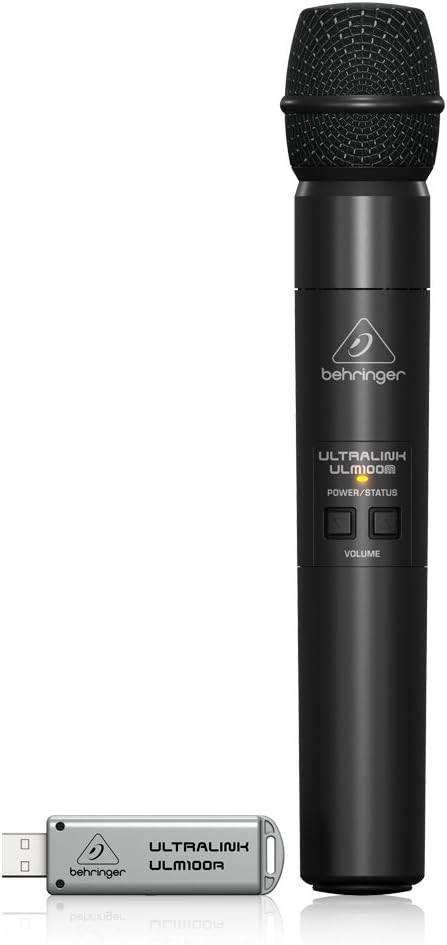
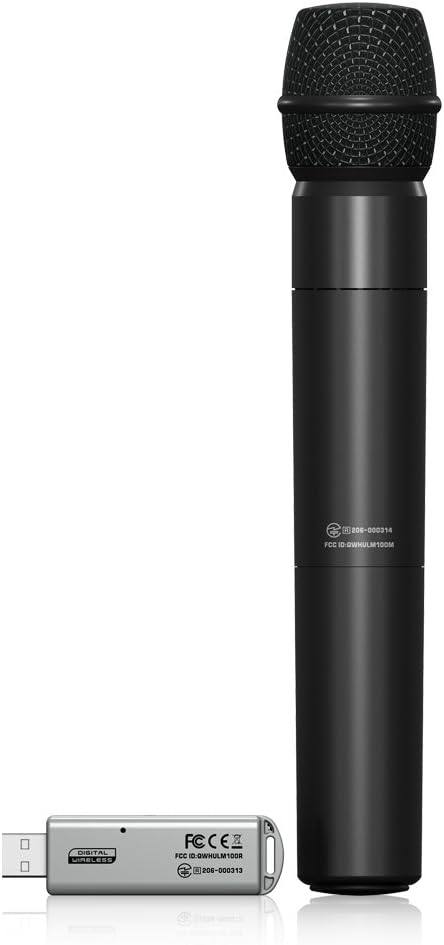

My read on the Behringer ULTRALINK ULM100USB is that it makes the most sense as a simple USB-first vocal tool, not as a do-everything microphone for every recording or live-sound rig. The key detail here is the USB connector. That tells me this mic belongs in a setup where the destination is a computer or another compatible USB-based system, rather than a traditional mixer channel or audio interface built around XLR inputs.
Where the ULM100USB fits best
At 7 ounces and 1.77 x 1.77 x 9.65 inches, the ULM100USB is in a very manageable handheld size range. I’d look at it for speech-heavy use first: presentations, classrooms, casual vocal work, rehearsal spaces, basic streaming setups, or simple public-address situations where the priority is getting a voice into a USB path without building a larger audio chain around it.
The battery-powered design is another part of that appeal. It requires 2 AA batteries, so it is not asking for phantom power at the microphone and it does not depend on a separate wall supply at the mic end. If I were buying for a straightforward computer-centered setup, that simplicity would be the main reason to consider it.
The catch with a USB microphone like this
I would be careful not to buy the ULM100USB just because it looks like a familiar handheld mic. The USB connector defines what it is good for, and it also defines what it is not good for. If your system is built around an analog mixer, a stage snake, or an audio interface with XLR microphone inputs, this would not be my first pick. In that kind of rig, I’d look for a conventional XLR microphone instead.
The AA battery requirement is also worth taking seriously. AA cells are easy to find, but they are still another item to manage. For longer sessions, I’d treat spare batteries as part of the kit, not something to remember later. That is not a dealbreaker, but it is a real practical limitation compared with a mic that draws power from the connected system.
Who I’d point toward the Behringer ULM100USB
- Good fit: someone who wants a lightweight, voice-focused microphone for a USB-based setup.
- Good fit: presenters, educators, casual performers, and creators working around a computer-centered audio path.
- Good fit: buyers who value a simple battery-powered setup and do not need traditional studio routing.
- Skip it: anyone who needs XLR compatibility, phantom-powered studio integration, or a microphone for a more complex live-sound system.
Reviews
There are no reviews yet.