
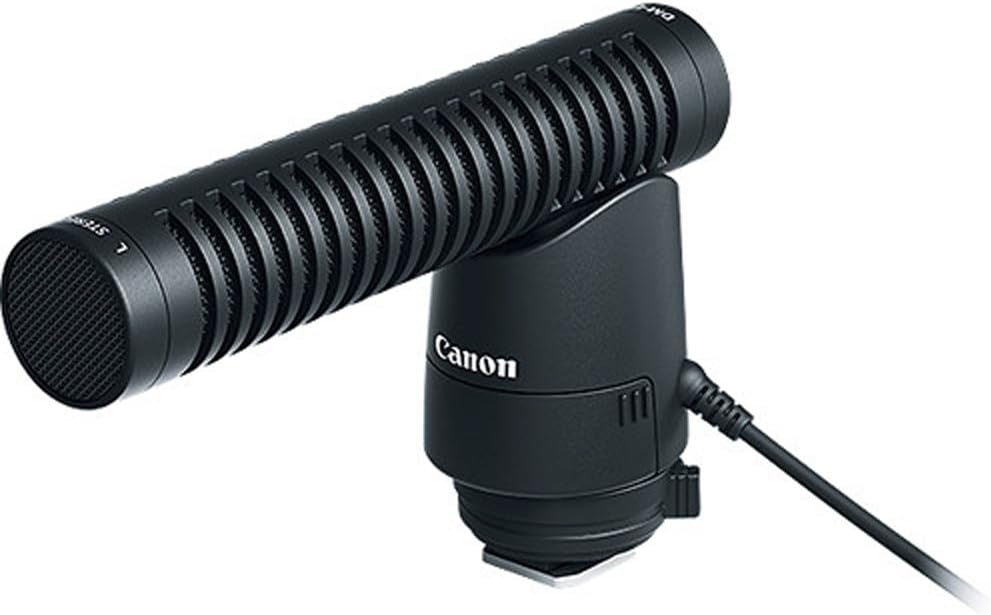

My read on the Canon DM-E1 is that it’s for camera shooters who want a more deliberate on-camera mic without building a separate audio rig. The spec that catches my eye first is the 80 dB signal-to-noise ratio, because noisy camera audio can make a clean-looking video feel amateur very quickly. The listed 42 dB audio sensitivity also suggests this is meant to be a practical upgrade over relying on a camera’s built-in pickup.
Why I’d treat the Canon DM-E1 as a camera-first mic
The DM-E1 is recorded as an XLR microphone for camera use, so I’d look at it mainly for a camera setup that already works with XLR or uses an adapter/interface built around that connection. XLR makes more sense to me on a planned video rig than on a casual compact setup, because it is the kind of connection people use when they care about a secure audio chain.
This is also listed as a single-channel microphone, so I would not buy it expecting wide stereo atmosphere. I’d think of it as a mono camera mic for dialogue, general scene sound, or a more focused source than the camera body itself. The shotgun form factor fits that idea: mount it with the camera, point the rig toward the subject, and keep the workflow simple.
The included windjammer is the part I’d actually care about
The box includes the Directional Microphone DM-E1, Windjammer for DM-E1, warranty card, and instruction manual. The windjammer matters. If I were putting together a small outdoor video kit, I’d rather have basic wind protection included than have to hunt for a matching accessory later.
Power is listed as battery powered, which cuts both ways. I like that it does not depend entirely on the camera supplying microphone power, but I would also make battery checks part of the shoot routine. At 3.8 x 5.3 x 3.2 inches and 7.2 ounces, this is not something I’d think of as a pocket audio solution. I’d treat it as a camera accessory for a prepared rig.
The omnidirectional listing is the spec that gives me pause
The biggest limitation is the recorded omnidirectional polar pattern. That matters because a shotgun-shaped mic is easy to assume will strongly reject sound from the sides, but an omnidirectional pattern is not what I’d choose when isolation is the priority. If I were filming in noisy rooms, near traffic, or anywhere one voice needed to stand apart from the surroundings, I’d be cautious.
The listed 16 KHz frequency response also makes me think of video speech and general camera sound rather than specialist music recording. I’d skip the DM-E1 if I needed stereo ambience, multi-channel capture, or strong off-axis rejection.
Verdict: I’d consider the Canon DM-E1 for a camera-based shooter who wants a battery-powered, XLR, mono microphone with a windjammer included. I would not choose it for noisy environments or anyone expecting tight shotgun-style isolation from the listed omnidirectional pickup.
Reviews
There are no reviews yet.