
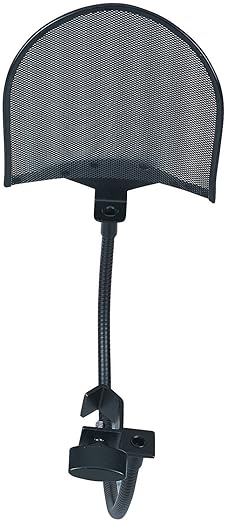

If I were trying to tame plosives in a fixed vocal or speech setup, the Avantone PS-1 PRO-SHIELD is the kind of accessory I’d consider before changing microphones. My read is simple: this is not meant to transform the sound of a recording chain. It is meant to put a physical barrier between the vocalist and the microphone capsule so “p,” “b,” and “t” bursts are less likely to hit the mic directly.
That makes it a practical studio tool for voiceover, podcasting, sung vocals, and close narration. I’d think of it as a control accessory rather than a tone accessory. If the problem is air movement from the mouth, a pop shield is relevant. If the problem is echo, computer fan noise, traffic, or a harsh room, this is not the fix I’d reach for.
Why I’d Pick a Pop Shield Over Foam Here
The natural comparison is a foam windscreen. Foam is easier when the mic is moving around, and it keeps the setup compact. But for a stationary microphone, I usually prefer the idea of a separate pop shield because it also gives the speaker or singer a visual distance marker.
That matters more than people think. A shield like the PS-1 can help create a repeatable working position in front of the mic. I would not choose it for handheld recording, walk-and-talk presenting, or a desk where the microphone already feels crowded. In those cases, a simpler foam windscreen may be the cleaner choice.
What the Avantone PS-1 Specs Tell Me
The Avantone PS-1 PRO-SHIELD is listed at 9.6 ounces, which reads to me as manageable for a typical fixed recording setup, though I’d still check how much extra weight and reach my stand can comfortably handle. Any accessory placed in front of a microphone changes the balance and the space around the mic.
Its listed dimensions are 15.51 x 7.99 x 0.51 inches. I read that as a broad, slim shield rather than a bulky enclosure. The 0.51-inch depth is the part I like on paper, because it suggests the shield should not eat up much front-to-back space. The larger face area should also be more forgiving than a very small screen when a vocalist shifts slightly.
The model number is PS-1, and it has been listed since June 14, 2007, so this is not a brand-new experiment. The recorded 1.5 Volts spec is not what I’d base the decision on; for this category, placement and mic technique matter far more.
Who I’d Buy It For, and Who Should Skip It
I’d look at the Avantone PS-1 PRO-SHIELD for fixed vocal booths, narration desks, podcast rigs, and singers who need a consistent working distance from the mic. I’d skip it if portability is the priority, if the mic is handheld, or if the real issue is an untreated room rather than plosive control.
Reviews
There are no reviews yet.